 WeddingFlow PH
Neither format is universally better—the right choice depends on your guest list, your budget, and the relationships involved.
That tension is real for Filipino couples. Your guest list spans multiple generations. Your titas and lolas expect a sealed envelope. Your barkada is on Viber. And your ate in Dubai will never get a physical card in time. This guide breaks down the cost, etiquette, RSVP reality, and a decision framework you can actually use.
Highlights
- Digital wedding invitations vs printed isn’t a competition—it’s a decision based on your guest list and budget.
- A static Canva JPG and a full interactive invite are two very different things.
- Printed suites for 150 guests can cost ₱22,500–₱80,000+ before delivery.
- Principal sponsors and grandparents should still receive physical cards.
- The hybrid model—printed for VIPs, digital for everyone else—is what most Filipino couples actually do.
What’s the Real Difference Between Digital and Printed Wedding Invitations?
It’s Not Just Format—It’s Function
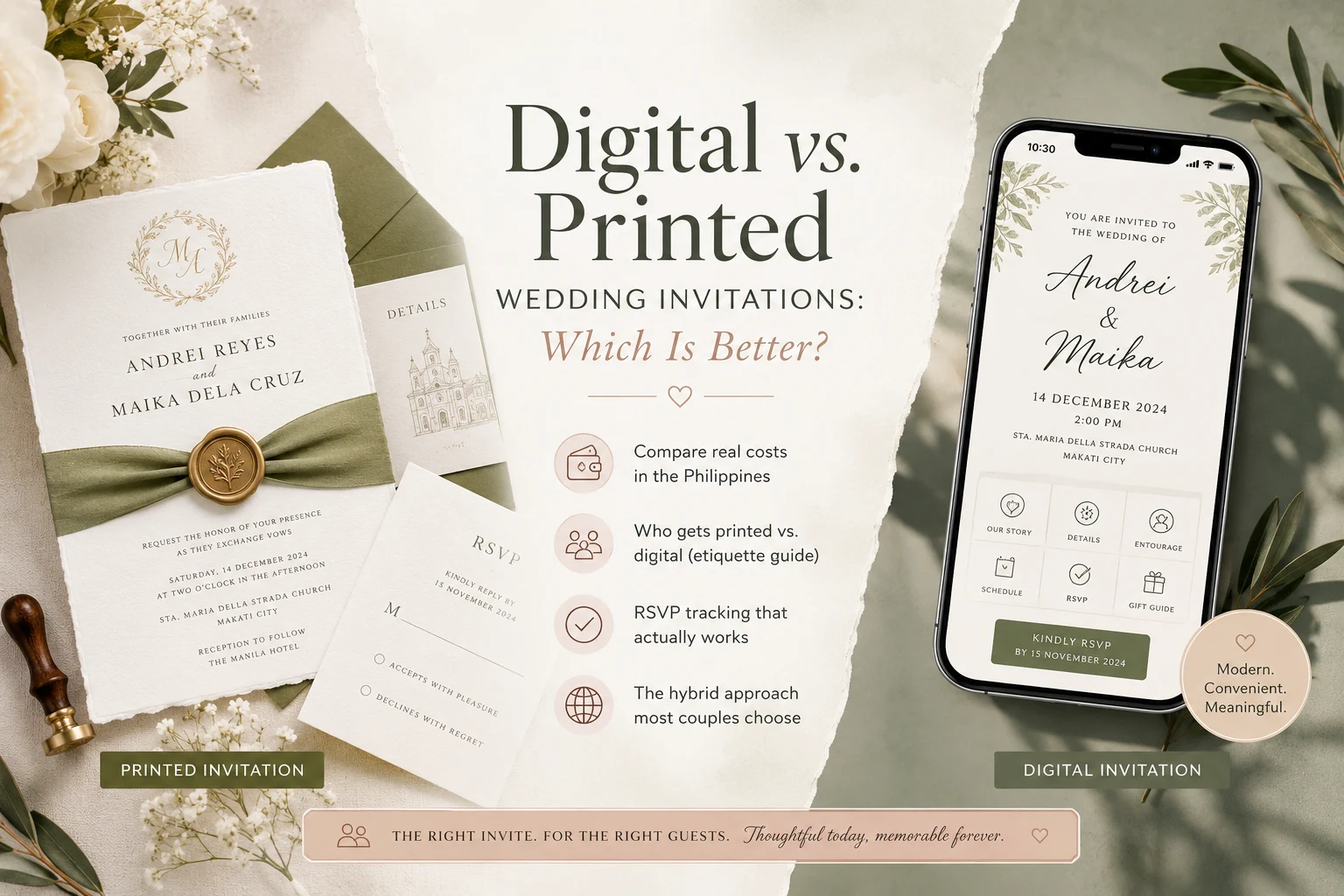
A printed invitation is a physically produced card suite—main card, RSVP slip, map insert, and reception card—delivered by hand or courier.
A digital wedding invitation is a shareable link or image file sent through Viber, Messenger, or email. That range matters. A Canva JPG shared in a group chat looks nice, but it can’t collect RSVPs, display your venue on a map, or update when plans change. Only an interactive digital invite can do all of that.
The Invitation Suite, Side by Side
Here’s how the three formats compare across what actually matters for a Filipino wedding:
| Feature | Printed Suite | Static Digital Image | Interactive Digital Invite |
| RSVP tracking | Manual (card or call) | Manual (message or call) | Automatic, real-time |
| Updatable after sending | No—reprint required | No | Yes, instantly |
| Guest map/directions | Insert card | None | Linked (e.g., Google Maps) |
| Ninong/ninang acknowledgment | Separate insert | Static display only | Dedicated section |
| GCash/Maya gift QR | Can be printed as static QR | Can be included as image | Built-in, scannable |
| Cost per guest | ₱30–₱800+ per suite | Very low | Low, one-time fee |
| Shareable via Viber/Messenger | No | Yes | Yes (link) |
The printed cost range depends on method: digital offset runs ₱30–₱80 per piece, letterpress ₱120–₱300+, and premium suites with foil or specialty stock up to ₱350–₱800+.
Cost Comparison: Digital vs. Printed Wedding Invitation Options in the Philippines
What Printed Invitations Actually Cost
The per-piece price is just the starting point. Here’s what a full printed suite actually costs for 150–200 guests:
- Printing: ₱30–₱800+ per piece depending on method
- Design fee: ₱3,000–₱15,000+ if you hire a stationer (zero if you supply a print-ready file)
- Assembly: Variable—ribbon, wax seals, and inserts all add up
- Courier: Local rates vary by province; international mailing for OFW relatives costs significantly more
At a mid-range suite of ₱150–₱400 per piece, 150 guests runs ₱22,500–₱80,000+ before delivery. Most couples are shocked because they only ever looked at the per-piece printing price.
What Digital Invitations Actually Cost
Canva’s free tier gives you a static image—no RSVP, no guest tracking, no management tools.
A platform-based interactive invite like WeddingFlowPH starts at ₱500 one-time for up to 100 guests, and ₱799 for up to 200 guests. Pricing scales in flat tiers—not per guest—so you’re never paying ₱30 × 200 the way printing demands. There’s no app to download and no monthly fees.
Paperless wedding invitations aren’t just cheaper—they also save you the hours spent coordinating with stationers, stuffing envelopes, and chasing courier updates. For couples with OFW family abroad, international postage alone can make printed invitations prohibitively expensive.
Filipino Wedding Etiquette: Who Gets a Printed Invite vs. a Digital One?
The Guests Who Expect a Physical Card
Some guests should always receive a printed invitation. Sending them a link isn’t just informal—it reads as disrespectful.
- Principal sponsors (ninong and ninang): They associate a physical card with being properly honored. A Messenger link feels like an afterthought.
- Grandparents and elderly relatives: Around 16% of the Philippine population still isn’t online—and that gap skews heavily older. A physical card is the only format that actually reaches them.
- Parents’ close family friends and respected elders: These are the people your parents care about most, and they expect to be honored with a formal card—not a group chat link.
- Any guest where “hiya” and “pakikisama” are at stake: A perceived slight on an invitation can outlast the wedding day in Filipino family dynamics.
The Guests Who Prefer Digital
On the other side of your list, a physical card is less practical—sometimes impossible.
- Your barkada and college friends: They live on Messenger. A link won’t get lost in a flooded apartment the way a card might.
- OFW family and international guests: Digital reaches them instantly. A physical card might arrive weeks late or not at all.
- Officemates and extended contacts: Professional acquaintances don’t need the weight of a formal card.
- Last-minute additions: When the RSVP deadline is close, digital is your only practical option.
The Hybrid Approach Most Filipino Couples Actually Use
Most Filipino couples land on a hybrid model: printed cards for 30–50 VIP guests, digital for everyone else. This isn’t a compromise—it’s the correct response to a multi-generational guest list.
You print premium suites for the guests who need them and send digital invitations to the rest. No important relationships get cut, and costs stay reasonable. Even in a fully digital setup, your ninong and ninang list should appear in a dedicated section—not buried in general content.
RSVP Reality: How Each Format Handles the Most Chaotic Part of Filipino Wedding Planning
You already know how this goes. Guests confirm, then go silent. Some show up with extra people. Others never respond but walk in anyway.
Printed RSVP cards are almost never returned in the Philippines—couples end up chasing guests by phone regardless. Group chat RSVPs get buried under memes and voice notes within hours. It’s a problem that has nothing to do with the invitation design and everything to do with Filipino RSVP culture.
With a digital invite, each guest taps the link, fills in their attendance, and submits—you see it instantly in your dashboard. Automated reminders go out to non-responders on a set date, without you personally following up with 200 people. Dietary preferences get collected in the same form, and your caterer gets cleaner numbers earlier.
The honest caveat: digital RSVP doesn’t eliminate all chaos—some guests will still walk in unannounced. But it cuts your manual follow-up work significantly. Printed RSVP cards are elegant but functionally unreliable for most Filipino weddings. They add cost without solving the problem.
Updating Your Invitation: What Happens When Plans Change
Venue moved. Ceremony time shifted. Typhoon season hit. Philippine weddings require flexibility, and your invitation needs to keep up.
According to PAGASA, the Philippines experiences an average of 20 tropical cyclones in the western Pacific each year, with about 8 or 9 crossing the country—most between July and October, which overlaps with popular wedding months. That’s not a hypothetical. It’s a planning reality.
Printed invitations are locked in—a venue change means a reprint, a new delivery run, and added cost. Static digital images are locked in, too—once you’ve shared a JPG across multiple group chats, you can’t update it everywhere. Only an interactive digital invite updates in real time: the link stays the same, the content changes. These aren’t edge cases—they’re common occurrences in Philippine wedding planning.
Sustainability and Generational Values: Does It Matter to Filipino Couples?
A full invitation suite—main card, RSVP card, details insert, and envelope—weighs approximately 30–50 grams per piece. Embellished suites with wax seals, ribbon, and pocket folds can tip well past 50 grams. For a 200-guest wedding, that adds up to 6–10 kg of single-use cardstock. Going fully digital eliminates that waste entirely without compromising your guests’ experience.
Gen Z and Millennial Filipino couples are increasingly factoring environmental impact into their wedding decisions. Going paperless is one easy, visible way to act on those values. Older guests generally aren’t the ones asking about sustainability—and that’s worth being honest about.
Frequently Asked Questions: Digital Wedding Invitations vs Printed in the Philippines
Is it rude to send digital invitations for a Filipino wedding?
Not for most guests—but yes for specific relationships. Principal sponsors, grandparents, and elderly relatives should always receive printed cards. For your barkada, officemates, and OFW family, digital is now fully accepted and often preferred.
How much do printed wedding invitations cost in the Philippines?
Per-piece costs run ₱30–₱80 for digital offset, ₱120–₱300+ for letterpress, and ₱350–₱800+ for premium foil suites. For 150–200 guests at a mid-range suite, total printing lands between ₱22,500 and ₱80,000+ before delivery. Design fees and courier costs aren’t usually included in per-piece quotes.
Can I do both printed and digital invitations?
Yes—and most Filipino couples do. Print for your principal sponsors, grandparents, and VIPs. Send digital to your barkada, officemates, OFW relatives, and extended contacts. One interactive link handles the majority of your guest list without losing any warmth or personalization.
How to Decide: A Simple Framework for Filipino Couples
Skip the generic pros-and-cons list. These three questions determine the right format for your wedding.
Question 1: Who’s on your guest list, and how old are they?
- Mostly younger guests—barkada, college friends: digital-first is practical and preferred.
- Multi-generational list with principal sponsors and grandparents: go hybrid.
Question 2: What’s your actual budget for invitations?
- Under ₱5,000: digital-only is the only option that doesn’t compromise quality.
- ₱5,000–₱20,000: hybrid—print for VIPs, digital for everyone else.
- ₱20,000+: a full printed suite with a digital supplement is viable; still send digital for international guests.
Question 3: How much time do you have?
- Less than 6 weeks to your wedding: digital only—printed suites need lead time for design, printing, and delivery.
- 3+ months out: either format works with proper planning.
Most Filipino couples find that the hybrid approach serves them best—printed for the guests who need it, digital for the rest.
Conclusion
Digital wedding invitations vs printed isn’t a decision between good and bad—it’s a decision about who’s receiving it. Printed cards carry real weight with principal sponsors, grandparents, and parents’ VIPs. Digital invitations are more practical, more affordable, and more flexible for the rest of your guest list.
Think about who’s on your list, what your budget is, and how much time you have—then make the call from there. The hybrid model works because it respects both formats for what they each do best.
If you’re ready to set up your digital invitation, WeddingFlowPH gives you one link that handles your RSVP, schedule, venue map, photo gallery, and gift registry with QR code—starting at ₱500, one-time, built for Filipino weddings.
Disclaimer: The information in this blog is for general wedding planning guidance only. Invitation etiquette norms and cultural expectations vary across regions, families, and communities in the Philippines—what applies to one guest list may not apply to another. Pricing figures for printed invitations are estimates based on publicly available industry ranges and are subject to change; always verify current rates directly with your chosen printer or stationer. WeddingFlow PH is not responsible for any relational, logistical, or financial outcomes resulting from invitation format decisions made based on this content. Platform features and pricing referenced are current as of publication and may be updated without prior notice.